Weather analysis reduces uncertainty — it does not eliminate it. The goal is to quantify your exposure accurately, not to predict what next year's weather will be.
Every construction project has a phase that carries disproportionate weather exposure. For most projects, that phase is earthwork. And it isn't particularly close.
- Earthwork is the most weather-sensitive phase on most projects — by a wide margin
- Most earthwork overruns don't come from shutdowns. They come from marginal days that quietly destroy production efficiency
- Recovery lag — the days after a rain event before soil is workable again — extends effective downtime well beyond what weather records show
- Two projects with identical total rainfall can have completely different earthwork outcomes depending on how those rain days are distributed
- Clay-heavy sites can lose 2–5 additional recovery days after a single rain event
- P80 earthwork exposure is often double what a simple historical average suggests
The Phase Estimators Underprice Every Time
Earthwork — site clearing, grading, excavation, soil prep, and compaction — is more sensitive to weather than any other construction activity. It stops in rain that wouldn't affect framing. It stops in freeze conditions that wouldn't touch interior work.
And unlike most other phases, a weather stop on earthwork doesn't just cost you the stopped days. It costs you the recovery time afterward.
Estimators who treat earthwork weather risk the same way they treat other phases consistently underprice it. The gap between what the estimate assumed and what the project actually encountered usually isn't a catastrophic storm. It's the accumulation of marginal conditions — and the slow recovery time that follows.
Earthwork Doesn't Have Two States. It Has Three.
Most construction activities are binary — they work in a given day's conditions or they don't. Rain above a threshold stops a concrete pour. Wind above a threshold grounds a crane. The day is lost, you move on.
Earthwork doesn't operate in a simple work/no-work binary. There's a third condition: reduced productivity.
Most estimates account for the red zone. The amber zone — 27 days of degraded output — is largely invisible in a weather contingency based on shutdown-day counts alone.
A day with 0.2 inches of rain doesn't necessarily stop earthwork. But it saturates the top soil layers, reduces equipment trafficability, increases fuel consumption, slows cycle times, and creates compaction problems that may require rework the following day.
It doesn't appear as a shutdown day in the weather record. But it's not a full-productivity day either.
Most earthwork overruns don't come from shutdowns. They come from marginal days that quietly destroy production efficiency — and the recovery time that follows.
This degraded zone is where most earthwork budget overruns originate. Standard weather contingencies, built around shutdown-day counts, miss it entirely.
Why Sequence Matters More Than Total Rainfall
Here's a concept that fundamentally changes how to model earthwork risk — and one most estimators never consider.
Two projects with identical total rainfall can have completely different earthwork outcomes depending on how those rain days are distributed.
A site that gets 12 rain days spread evenly across a 60-day window is a very different problem from a site that gets 12 rain days clustered into two back-to-back weeks. The total precipitation is identical. The schedule impact is not.
Clustered rain events create compounding recovery lag — the soil doesn't have time to drain between events, recovery time stacks, and effective productivity collapses for extended stretches.
Consecutive-event analysis — how often does this location historically see multi-day rain sequences — matters for earthwork sequencing in a way it doesn't for most other phases. Historical workable-day totals don't capture this. Distribution analysis does.
The Atlanta Example: What the Numbers Actually Show
Consider a 90-day rough grading and site work scope in the greater Atlanta area running October through December — a common project window for commercial site work in the southeast.
Xyloclime Pro pulls 30 years of NOAA and ERA5 data for the project location, applies recency weighting so recent years carry more influence than older ones, and models workable days against earthwork-specific thresholds.
Simple 30-year average: 19 non-workable days
Recency-weighted P50 (median year): 24 non-workable days
Recency-weighted P80 (one-in-five year): 34 non-workable days
P80 adjusted for clay-site recovery lag (~1.5× on multi-day events): ~40 effective non-productive days
The gap between the simple average (19 days) and the P80 soil-adjusted estimate (40 days): 21 additional days of exposure. At a typical earthwork crew and equipment cost of $14,000–$18,000 per day, that's $294,000–$378,000 in unpriced exposure — from a moderately bad weather year, not a catastrophe.
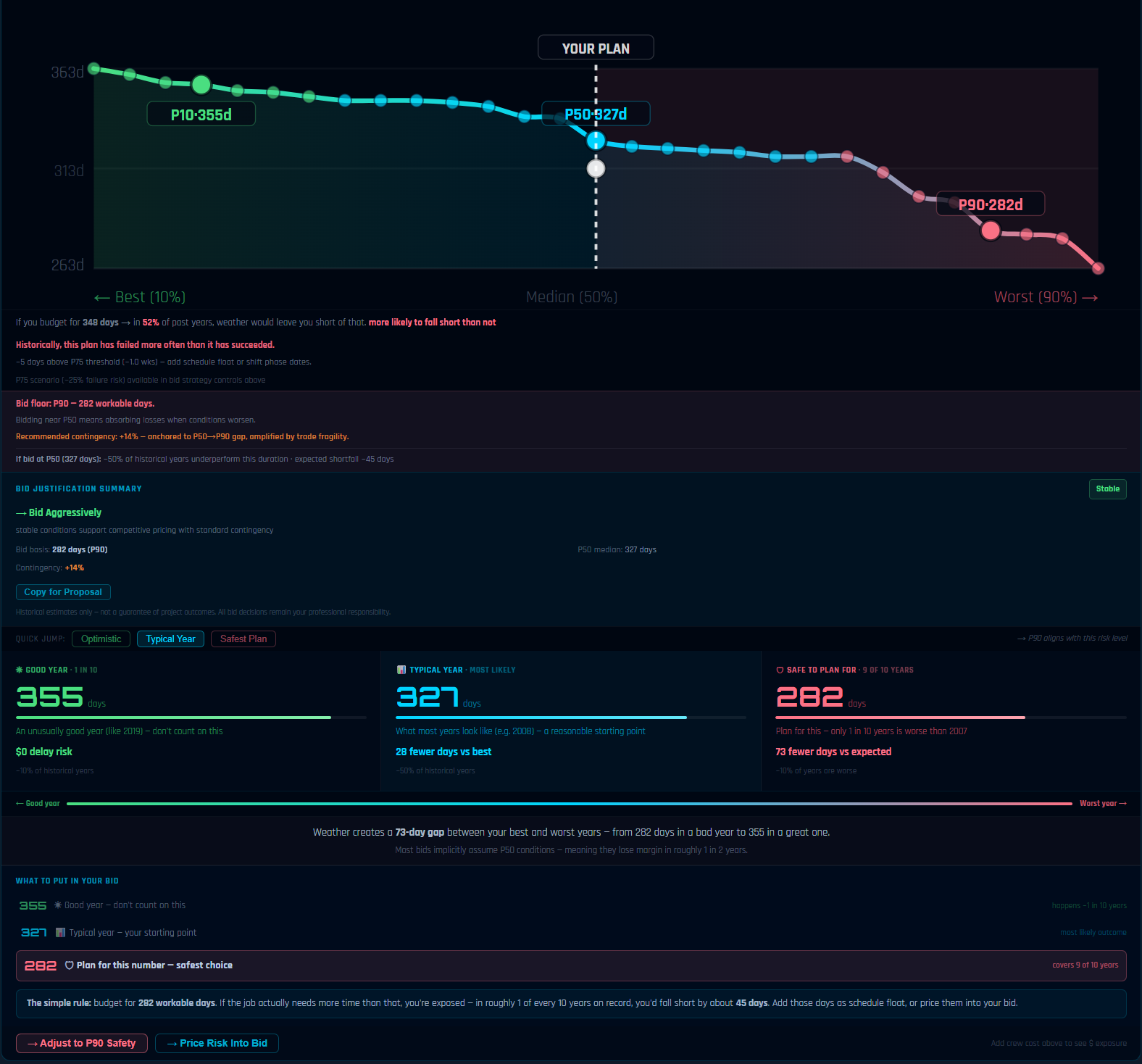
P50 and P80 represent the median and 80th percentile of historical year outcomes for this location and window. P80 occurs roughly one in five years.
Soil Conditions Can Double Your Weather Exposure
Weather thresholds for earthwork aren't universal. They depend heavily on soil conditions — and the difference between soil types is not marginal.
Recovery times are approximate and depend on drainage, event severity, and compaction specification requirements. Clay sites with poor drainage represent the worst-case scenario in most U.S. markets.
Clay-heavy soils absorb water slowly and release it slowly. A saturated clay site may not be workable for several days after rain stops. Clay also has a narrow compaction moisture window — material that arrives too wet fails testing, requires removal or drying, and creates quality problems beyond the weather delay itself.
Sandy and granular soils drain faster and recover more quickly. The same rain event that shuts a clay site down for a week may leave a sandy site workable within 24 hours. If your project is on well-draining granular soil, a historical rain-day count will overstate your actual exposure.
This means location-level weather analysis has to be combined with site-specific soil knowledge to produce a defensible earthwork weather allowance. The weather data tells you how many events to expect. The soil conditions tell you how long each one costs you.
Earthwork Timing Is Usually the Biggest Risk Variable
The single biggest lever in earthwork weather risk isn't contingency size — it's sequencing. When earthwork runs relative to the seasonal weather window determines more of the risk than almost anything else.
- Spring start (Mar–May): runs through the tail of wet season, picks up the dry summer window, completes before fall rains. In most U.S. markets this is the lowest-risk earthwork window — extended dry periods, stable soil, good compaction conditions.
- Summer start (Jun–Aug): moderate risk in most markets. Primary exposure is heat-related productivity loss in southern states, occasional severe storms in the mid-continent. Generally favorable for soil conditions.
- Fall start (Sep–Nov): risk increases materially as the schedule extends into the freeze-thaw exposure window. In northern markets, this often means losing December through February on frost-sensitive compaction work.
- Winter start (Dec–Feb): highest risk in northern markets. Freeze-thaw cycles disrupt compaction, specifications often require frost-free subgrade, and recovery windows are compressed.
The historical workable-day distribution for a site tells you exactly what each starting month costs in expected non-productive days. That comparison — run before bid — is the most powerful tool an estimator has for influencing the project schedule.
Pricing Earthwork Weather Risk in Practice
A few principles that hold across most earthwork scopes:
Don't pool earthwork weather risk with the project-wide weather contingency. Earthwork risk is materially higher than the rest of the project. Blending it into a single project percentage understates the earthwork exposure and wastes contingency on phases that don't need it.
Separate shutdown days from productivity drag. Budget shutdown days as schedule float. Budget productivity drag — the degraded-output days around weather events — as a labor efficiency factor in the earthwork crew cost, not as additional calendar days.
Account for recovery lag on clay or poorly draining sites. A multiplier on multi-day rain event recovery time is a reasonable starting point for clay-heavy sites in wet climates. The right number depends on site drainage, soil classification, and specification requirements — but ignoring it entirely is rarely defensible on a clay site in the mid-Atlantic, southeast, or midwest.
Evaluate both P50 and P80 scenarios. Many contractors find it useful to present both to the owner. P50 is the base case. P80 is the risk story — it quantifies what a moderately bad weather year costs and provides the basis for a defensible contingency discussion rather than a round-number markup.
Model sequences, not just totals. Ask whether your project window historically produces clustered multi-day events or isolated single-day events. The answer has a larger impact on earthwork schedule risk than the total day count.
Estimators have had access to weather records for decades. What they haven't had is activity-specific modeling tied to actual field conditions — earthwork thresholds, soil-appropriate recovery curves, and sequence analysis built into the workable-day count. That's the gap between a defensible earthwork estimate and one that gets rebuilt in the field.
Quantify Your Earthwork Exposure Before It Becomes a Schedule Problem
P50 and P80 workable-day counts — by phase, by location, by activity typeXyloclime Pro combines 30 years of NOAA and ERA5 data with recency weighting and activity-specific thresholds to model earthwork, concrete, structural, and other phase exposure for any U.S. project location.
Start Free 7-Day TrialNo charge for 7 days. Cancel anytime before day 8.